
- Looking tired despite adequate sleep usually points to a structural change in the face.
- Eye bags, ptosis, brow descent, and volume loss each produce a distinct appearance and have different underlying causes.
- The treatment approach is determined by the underlying factors present in a patient's condition. Addressing upper lid skin when ptosis is the actual problem, for example, tends to produce an incomplete result.
- Each cause has a corresponding surgical option. A personalised assessment determines which approach, if any, is appropriate.
The upper face is one of the more misread areas in cosmetic surgery, both by patients and by some websites that discuss it. Individuals seeking rejuvenation often arrive convinced they require upper eyelid surgery when the underlying issue is a quietly descended forehead and brow. Conversely, others assume a brow lift is necessary when the primary concern is localised tissue laxity along the upper eyelid fold.
In many cases, an optimal result requires addressing both areas simultaneously. This is not about performing additional procedures unnecessarily, but about treating distinct anatomical layers within the same functional unit. This article outlines how brow lifts and eyelid surgery relate, when each procedure is indicated individually, and when combining them yields a more balanced, natural result.
Understanding the Upper Face as One Connected Area
The brows and upper eyelids share a close anatomical and visual relationship. When the brows descend with age, it adds weight to the upper eyelids. When the upper lid skin loosens, they crowd the eye. The two changes often happen in parallel, and they reinforce each other. In response, individuals often unconsciously contract their frontalis (forehead) muscle to lift the brow and clear their visual field, creating deep horizontal forehead lines. This is why focusing on the eyelid alone, or the brow alone, sometimes produces an incomplete result. The upper face is best assessed as a single connected area, even when only one part of it ends up being treated.
What a Browlift Addresses
A browlift is a surgical procedure that repositions the eyebrows to a natural, anatomically youthful level on the orbital rim. It addresses descended or heavy brows, the deep horizontal forehead lines that often build up from the habit of lifting the brows just to see properly, and the crowded, weighted appearance of the upper face that brow descent tends to produce.
The primary indication that may suggest a browlift:
- Brow Ptosis: Descent of the outer tail or main body of the eyebrow below the superior orbital rim.
- Forehead Furrowing: Deep horizontal forehead lines resulting from chronic compensatory muscle contraction.
- Interbrow Glabellar Lines: Structural frown lines caused by overactive corrugator and procerus muscles.
There are a few brow lift approaches, varied for different purposes:
- Endoscopic Brow Lift: Uses keyhole incisions concealed within the hairline to elevate and fixate soft tissue structures using a small camera.
- Temporal / Lateral Brow Lift: Focuses specifically on elevating the outer third (tail) of the brow via localised temporal hairline incisions.
- Coronal or Trichophytic Lift: Indicated for patients requiring significant elevation or hairline height modification.
Where the brow descent is genuinely mild, a non-surgical option such as a face thread lift may also be discussed, though it produces a subtler change and is not a substitute for surgery in patients with more meaningful descent.
What Eyelid Surgery Addresses
Upper eyelid surgery (upper blepharoplasty) removes excess skin and, where appropriate, a small amount of fat from the upper eyelid to restore a more open, defined lid. It addresses hooded or heavy upper lids, eye makeup that disappears into the crease, and the sense that the eyes look smaller or more tired than they used to.
A related but distinct procedure, ptosis surgery, corrects a droopy upper lid caused by a weakened lifting muscle within the lid. It is sometimes performed alongside or instead of upper blepharoplasty, depending on what is actually causing the lid to sit low.
Do I Need a Brow Lift or Blepharoplasty?
So do you need a brow lift or a blepharoplasty? That is the question most readers arrive at, and it is genuinely answerable once the right anatomy is looked at. A few patterns tend to point the way.
You may need a browlift if:
- Your eyebrows sit lower in the current photos than they used to
- You find yourself constantly lifting your brows to see properly or feel alert
- You have deep horizontal forehead lines from this compensatory lifting
- The upper face looks heavy and crowded, even when the eyelid skin itself does not seem to be the main issue
You may need blepharoplasty if:
- There is excess skin on the upper lid that you can pinch, or that folds over the natural crease
- Eyeshadow disappears into a fold and is no longer visible when your eyes are open
- The upper lid skin touches or rests on your lashes
You may need both if your brows have descended and your lid skin is excessive, or if treating one alone is likely to leave the upper face looking unbalanced. That last judgement is one that an in-person assessment is built to make, because the relationships between brow, lid, eye and forehead vary considerably from person to person.
The right diagnosis matters just as much as the right procedure. A reader who has a brow problem treated with eyelid surgery alone may still feel that the upper face looks heavy afterwards, even though the surgery itself was done well.
Brow Lift vs Eyelid Surgery
Here is how the two compare, side by side.
Browlift | Eyelid surgery (blepharoplasty) | |
What it changes | The position of the brow on the forehead, opening the upper face and reducing heaviness above the eye | The upper lid itself, removing excess skin and refining the lid crease, opening the eye |
Recovery | Somewhat longer, with swelling, bruising and some scalp numbness or tightness that settles over the following weeks | Generally shorter and less involved; most patients return to most activities within one to two weeks |
Long-term results | Lifts the upper face, but in patients with excess lid skin, the lid will still appear crowded under the newly lifted brow | Clear improvement to the lid itself, but in patients with significant brow descent, the upper face may still read as heavy |
When the two are combined, the recovery is bundled into one period rather than spread across two. For patients who genuinely need both, the result also tends to be more harmonious than either procedure could deliver on its own.
When Combining the Two Procedures Makes Sense
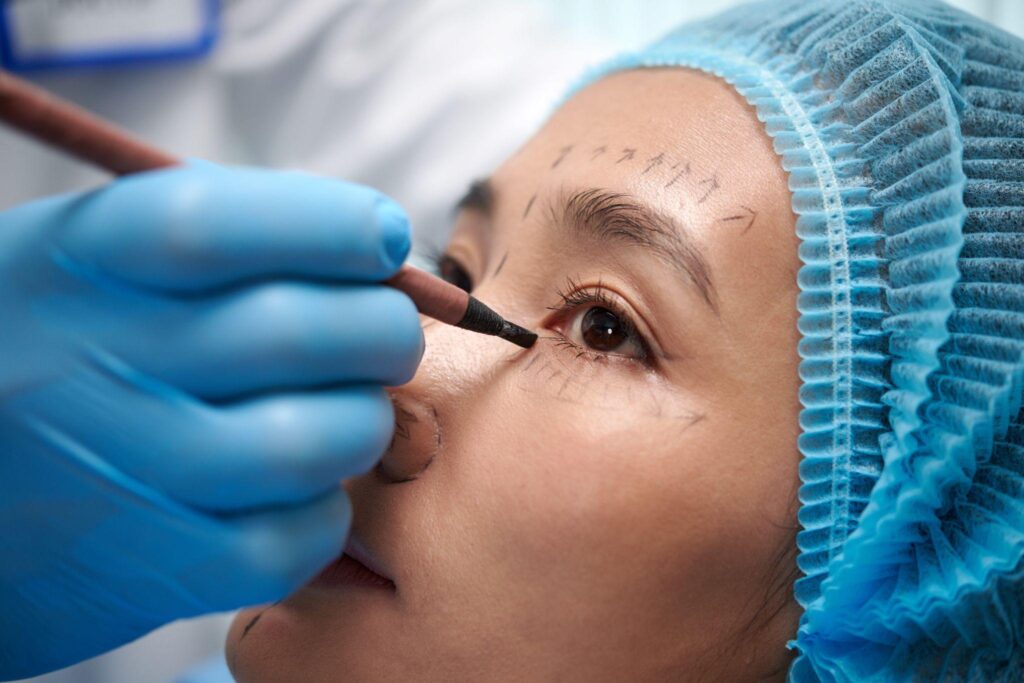
Combining an endoscopic brow lift with an upper blepharoplasty is a common pairing in facial rejuvenation for several clinical reasons:
- Harmonious Structural Rebalancing: Elevating the brow restores the upper foundation first. The surgeon can then precisely measure and excise only the true excess eyelid skin, preventing over-resection of lid tissue.
- Single Anaesthetic & Recovery Phase: Combining treatments consolidates downtime into a single 10-to-14-day recovery window rather than staging separate operations months apart.
- Comprehensive Rejuvenation: When broader procedures (such as a facelift or autologous facial fat grafting) are planned, addressing the upper face simultaneously produces balanced results across all facial tiers.
When One Procedure Alone Is the Right Choice
Just as importantly, combining is not always better. If the brow position is essentially unchanged and the issue is genuinely confined to the upper lid, blepharoplasty alone is often the cleaner answer. If the upper lid skin is in good condition but the brow has descended, a browlift on its own may produce the desired result. And if a patient’s anatomy or general health makes a longer combined procedure less suitable, staging the two operations across separate recoveries may be safer.
This is the kind of decision that takes careful consultation with your surgeon, not a default approach.
What to Expect From a Consultation
A comprehensive consultation focuses entirely on finding the right anatomical match for your goals, whether that involves surgery or a more conservative approach. A thorough evaluation systematically covers:
- Comprehensive Anatomical Mapping: Evaluating brow height, eyelid skin redundancy, and underlying muscle dynamics around the orbital region.
- Functional & Tissue Assessment: Assessing skin elasticity, tear film stability, and eyelid muscle function to ensure safe, comfortable outcomes.
- Realistic Expectation Setting: Discussing transparently what each approach can realistically achieve for your unique features.
At Argent Plastic Surgery, Dr Lee Hanjing creates individualised treatment pathways tailored to your specific facial proportions. Following a careful evaluation, the recommended approach may involve an isolated brow lift, upper blepharoplasty, a combined procedure, or non-surgical monitoring.
Making the Right Decision for Your Upper Face
A browlift and eyelid surgery address different parts of the same connected area. Combining them can produce a more balanced result for patients who genuinely need both, while treating only one is often the right call for patients who do not. The most important step is not choosing between the procedures in advance, but having a careful assessment that identifies what is actually driving the appearance you want to change.
If you have begun to think about an eyebrow lift and blepharoplasty, or are weighing one against the other, a consultation with Dr Lee Hanjing at Argent Plastic Surgery offers a thorough assessment of whether a browlift, eyelid surgery, or a combination is the right fit for you.