Otoplasty (Prominent Ear Correction) in Singapore

For a child who has begun to notice that their ears stand out, or an adult who has lived with it quietly for years, otoplasty offers a measured way to bring the ears closer to the head. Also known as prominent ear correction, this surgical procedure reshapes the underlying ear cartilage and does not affect hearing or the ear's internal structure.
At Argent Plastic Surgery, otoplasty is performed by Dr Lee Hanjing, an MOH-accredited, SMC-registered Consultant Plastic Surgeon (FAMS) who specialises in Paediatric Plastic Surgery, at Mount Alvernia Hospital, for both children and adults.
What Are Prominent Ears?
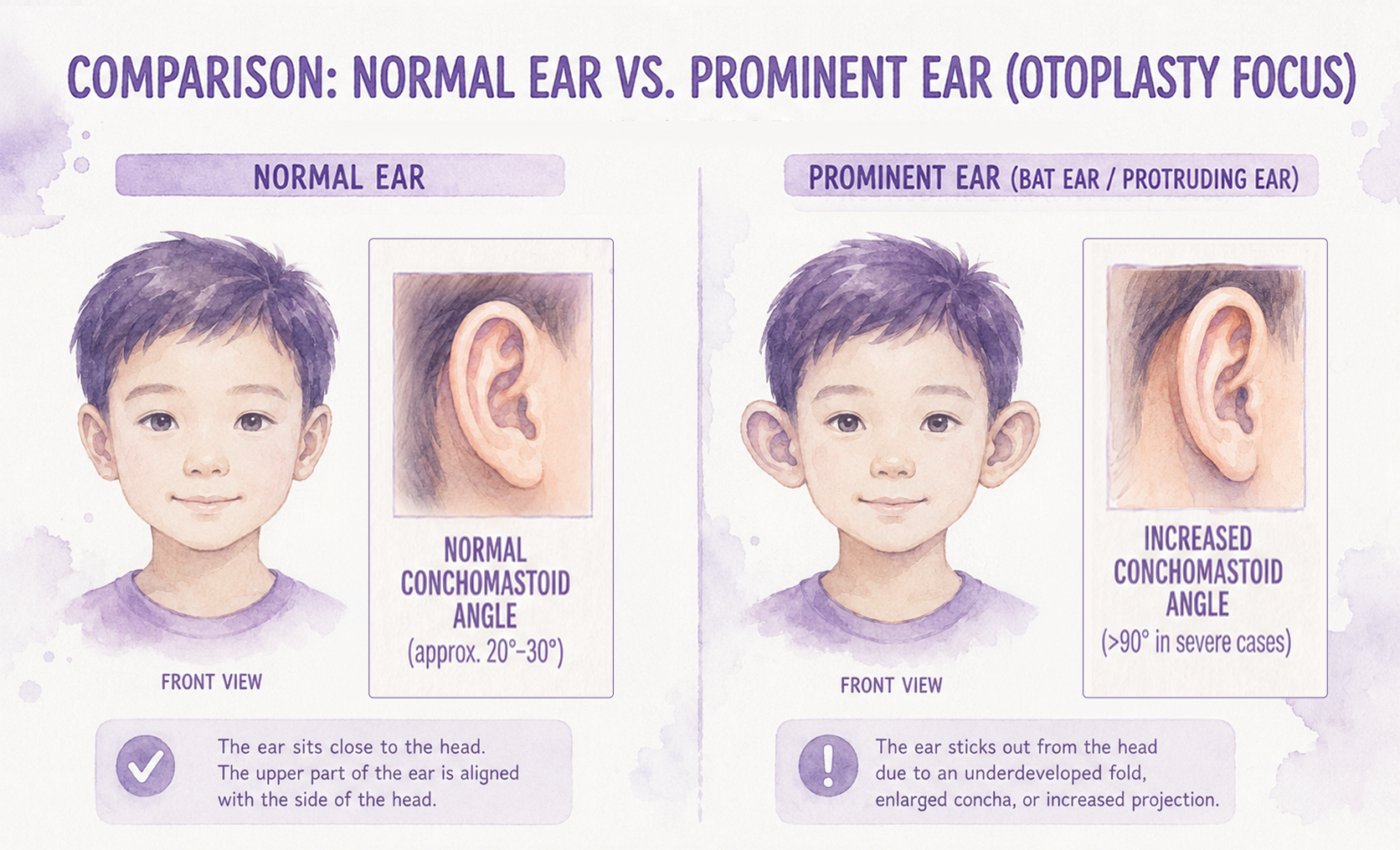
Prominent ears are those that protrude farther from the sides of the head than usual. Prominent ears are ears that protrude further from the side of the head than is typical. This is entirely structural; it is not a matter of sleep habits or early childhood care and comes down to natural variations in how the ear cartilage forms. There are three principal anatomical reasons an ear sits forward:
- An underdeveloped or absent antihelical fold. The antihelical fold is the inner ridge of cartilage that normally curves the upper ear gently backward. When it has not formed fully, the upper ear has nothing to fold against, and it tips outward.
- An overly deep conchal bowl. The concha is the cupped hollow at the centre of the ear. When its depth is excessive, it sets the whole ear further out from the head.
- A combination of both. When a weak fold and a deep bowl occur together, the protrusion is more pronounced, and because each ear is rarely affected to the same degree, a measure of asymmetry usually follows.
Otoplasty is the surgical procedure that reshapes and repositions this cartilage to bring the ears into a more natural position. It addresses the appearance of the ear and does not affect hearing.
Who Is Suitable for Otoplasty?
Suitability for otoplasty depends significantly on anatomy, general physical health, and emotional maturity. The approach differs naturally between young children and adults.
Otoplasty for Children
A significant portion of our clinical work focuses on pediatric surgery. Prominent ear correction in young patients is approached with extra care, focusing on three major areas:
- Timing: Surgery is typically considered around the age of five or six, before a child begins primary school. By this stage, the ear has reached roughly 85% to 90% of its adult size, meaning the cartilage is strong enough to hold shapes securely. Correcting it early can save a child from feeling self-conscious among peers.
- Anaesthesia: For young children, otoplasty is safely carried out under general anaesthesia, closely monitored by the experienced pediatric anaesthesia team at Mount Alvernia Hospital.
- Parental Support: We keep parents close to the process at every step, explaining the techniques in plain language so you can make a decision at your own pace.
Otoplasty for Adults and Adolescents
There is no upper age limit for an ear correction. Many older adolescents and adults choose to undergo the procedure in their late teens or twenties after weighing it quietly for years. For an adult, otoplasty is entirely a personal choice to improve facial harmony or clothing comfort (such as wearing helmets or pulling hair back safely), and we treat it with that exact independence in mind.
What to Expect on the Day of Surgery
Anaesthesia: Adults and older teenagers usually undergo otoplasty under local anaesthesia with sedation, ensuring the ears are completely numbed while you remain relaxed. Children are placed comfortably to sleep under general anaesthesia.
Duration: The procedure typically takes 1 to 2 hours, depending on whether one or both ears are being reshaped.
Discharge: Performed as a day surgery at Mount Alvernia Hospital, meaning you or your child can return home to rest on the same day. A soft, protective dressing or headband is applied immediately after surgery to support the new shape.
Recovery After Otoplasty
Recovery is generally straightforward, and it helps to know what each stage typically involves. The timings below are typical; your own recovery is reviewed at each follow-up.
Immediately after. Mild swelling, tenderness and some bruising around the ears are normal in the first days. Your doctor will recommend you to wear a protective headband to cushion and support the ears.
The first one to two weeks. The headband is worn consistently through this period, including at night, to protect the result. Stitches are removed or dissolve within roughly a week. Adults are typically comfortable returning to desk-based work after about five days, and children usually go back to school within a week.
Weeks two to six. Activity returns gradually. Strenuous exercise and contact sports are best set aside for four to six weeks, giving the cartilage time to settle securely into its new position.
Long term. The remaining swelling eases over the following weeks, and the final result typically becomes apparent within two to three months. The results from otoplasty are generally long-lasting, as the reshaped cartilage holds the position it has been given.
Cost of Otoplasty in Singapore
Because every ear shape requires a slightly different surgical approach, the cost of an otoplasty is fully customised. Key factors influencing the price include:
- Whether the procedure is unilateral (one ear) or bilateral (both ears).
- The specific combination of techniques required (e.g., scoring vs. conchal reduction).
- The type of anaesthesia used (local sedation for adults vs. general anaesthesia for children).
- Hospital operating theatre and facility fees at Mount Alvernia Hospital.
Medisave and Insurance Guidelines
- Cosmetic Otoplasty: If the surgery is performed purely to improve appearance or reduce protrusion, it is classified as cosmetic and is not claimable under MediSave or private insurance.
- Reconstructive Otoplasty: If the procedure is addressing a documented congenital deformity present from birth, a structural ear defect, or trauma-related injury, partial coverage under MediSave or insurance may be possible. We recommend checking your specific policy terms against current guidelines.